
Picture this: you’re on a popular decentralized exchange, about to sign a swap that looks routine — two tokens, a slippage parameter, a gas estimate — and you trust the interface because your wallet popped up, approved, and the green button said “Confirm.” Two minutes later you discover a tiny allowance you granted allowed an exploited contract to drain funds, or the gas consumed was far higher than the UI suggested. That scenario is familiar enough to keep even experienced US-based DeFi traders awake. The central question is not whether wallet UX can be slick; it’s whether the wallet helps you actually understand the consequences of signing a transaction before you do it.
This article examines how a security- and simulation-first browser wallet — exemplified by Rabby’s Chrome/Chromium extension — changes the mechanics of signing, where that improvement helps most, and where it still leaves risk. My aim is to move beyond slogans and describe the mechanism, trade-offs, and practical heuristics a DeFi power user needs when choosing a multi-chain extension.
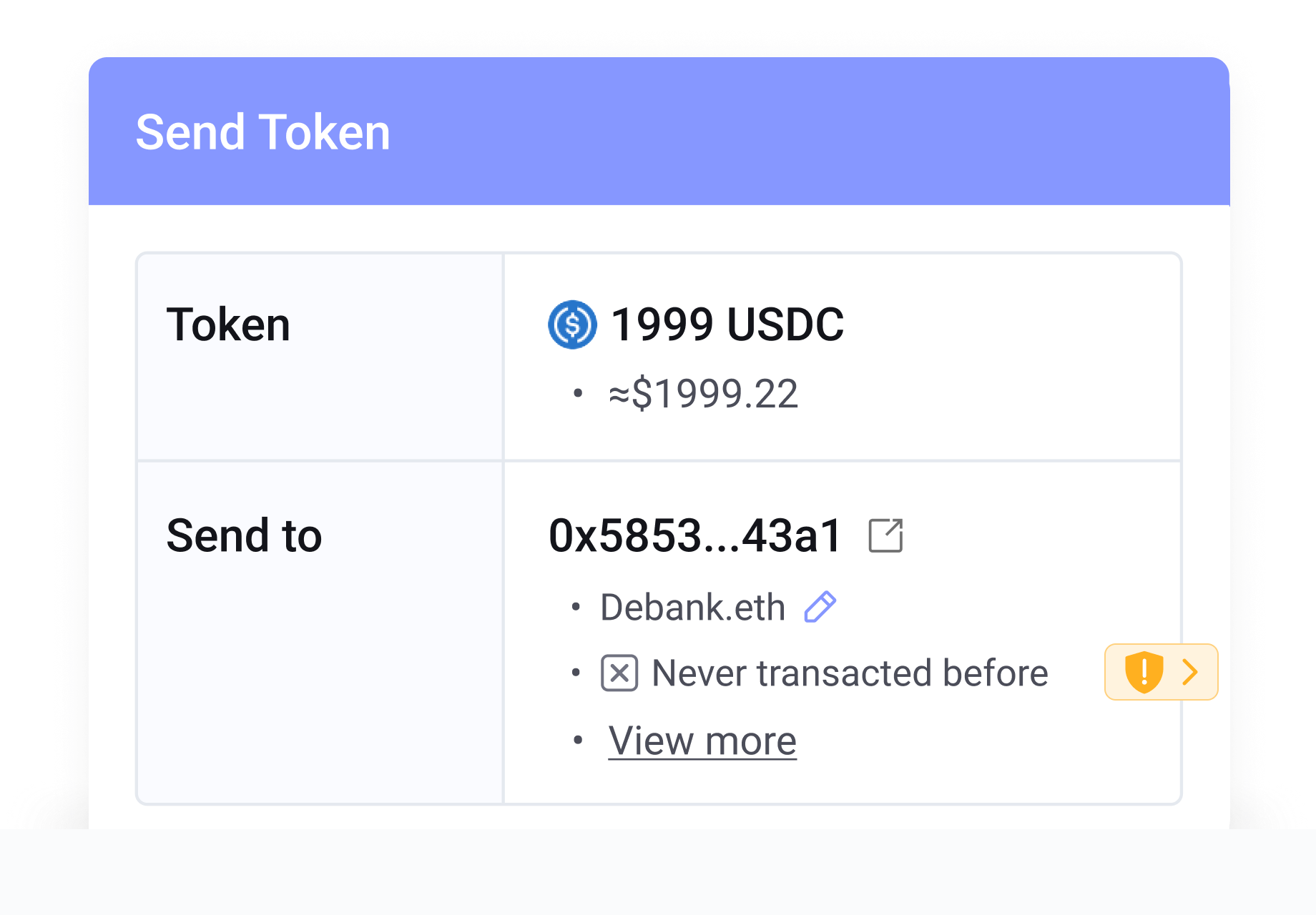
Mechanism first: how transaction simulation and pre-scan actually work
At a basic level, transaction simulation is the practice of executing a proposed transaction against a local or remote node in a read-only mode to estimate exactly what state changes will occur without broadcasting the transaction to the network. For a DeFi swap, that means the wallet runs the call, inspects token transfer events, resulting balances, and gas used — then renders a human-readable summary (token delta, recipient addresses, explicit fees). Rabby’s extension automates this step and surfaces a line-item view of estimated token inflows and outflows plus fee breakdowns before the user hits “Confirm.”
Layered on top of simulation is a pre-transaction risk scan: pattern matching and heuristic checks that flag known-bad contracts, unusually large allowance requests, transfers to zero or contract-deployer addresses, or references to known exploit signatures. Rabby couples these with an approval-revocation tool so users can immediately prune allowances if needed. That combination — simulation plus risk scanning plus revocation — converts a single binary “sign or don’t” decision into a more informed, actionable workflow.
What this changes in practice: three concrete behaviors for power users
First, blind signing is reduced. When the wallet tells you exactly which tokens will move and how much gas will be consumed, you can compare the simulated outcome to the dApp’s own estimates and to on-chain explorers. Discrepancies are a red flag: if the dApp says you’re swapping 100 USDC for 0.1 ETH but the simulated balance delta is different, that signals a possible front-running, sandwiching, or malicious intermediary.
Second, faster, safer multi-chain workflows. Rabby supports 90+ EVM-compatible chains and will automatically switch networks based on the dApp you visit. For traders hopping across Arbitrum, Optimism, Polygon, and BNB Chain, that removes a common operational error — signing on the wrong network — which in turn prevents confused transactions and costly retries.
Third, institutional and hardware integrations. Rabby is not only a solo-operator extension: it integrates with multi-sig and enterprise custody solutions (Gnosis Safe, Fireblocks and similar). For teams and funds that require co-signed operations, having pre-simulation and the same dashboard across devices preserves the audit trail and reduces avoidable slips in multi-party governance flows.
Trade-offs and limits: what simulation and pre-scan do not solve
Simulation is powerful but not omnipotent. It cannot predict off-chain actions, or revoked state changes that depend on future oracle updates, and it will not stop you from interacting with a legitimately deceptive frontend that misleads users into signing benign-looking transactions that execute complex state machine logic on-chain. Simulated gas may differ from real gas usage under congestion or miner/validator reordering. Importantly, the simulation’s accuracy depends on the node and JSON-RPC provider used; a stale or filtered provider can omit mempool dynamics.
Rabby’s known limitations matter: there’s no native fiat on-ramp inside the extension, so for US users who prefer buying crypto with a bank or card without leaving the wallet, that convenience is missing. Also, if you expect one-click in-wallet staking flows for a dozen protocols, Rabby doesn’t aim to be a staking hub — those actions still require visiting staking dApps and rely on the same simulation safeguards to prevent surprises.
Past incidents should be weighed honestly. The 2022 Rabby Swap contract exploit that lost roughly $190,000 is a reminder that even security-conscious projects can be affected by smart contract vulnerabilities. The response — freezing the contract, compensating users, and strengthening audits — is evidence of good operational hygiene, but it also highlights a structural reality: a wallet’s extension logic can be robust while the smart contracts it interacts with remain a point of systemic risk.
For more information, visit rabby wallet extension.
Comparative perspective: Rabby vs. mainstream alternatives
MetaMask remains the default for many users because of ubiquity; Coinbase Wallet and Trust Wallet aim for broad user audience and fiat-centric onboarding. Rabby differentiates by embedding pre-simulation, approval management, and automatic network switching as primary features rather than add-ons. For a DeFi power user, that changes the risk calculus: if your workflows involve many unfamiliar contracts or cross-chain operations, the marginal value of simulation and revocation can exceed the convenience costs of switching wallets or adding an extension.
But there are trade-offs: MetaMask has deeper marketplace integration and a larger third-party ecosystem, which can make some dApp integrations smoother. Also, any open-source wallet (including Rabby, which is MIT-licensed) benefits from public audits, but open source is a necessary, not a sufficient, condition for safety: maintenance speed, security bounty programs, and the quality of external audits still matter.
Decision heuristics for a US-based DeFi power user
Here are practical rules of thumb to decide whether to adopt a simulation-first multi-chain extension:
– If you routinely interact with new contracts, swaps across unfamiliar liquidity pools, or need precise pre-trade visibility, prefer a wallet that simulates and displays token deltas. The immediate signal-to-noise reduction is valuable. – If you manage institutional funds or large balances, insist on hardware wallet integration and multi-sig compatibility; Rabby supports Ledger, Trezor, Keystone and integrates with Gnosis Safe, which aligns with enterprise controls. – If you rely on seamless fiat buy-in, expect to combine tools: keep a custody or exchange account for fiat purchase, then move funds to the wallet; Rabby does not include an in-extension fiat on-ramp. – If you trade on low-liquidity chains, use the cross-chain gas top-up feature strategically: it prevents stuck transactions when a target chain lacks gas tokens, but it doesn’t replace proper slippage and routing checks.
What to watch next: signals that would change the balance of benefits
Monitor four signals that would materially change the evaluation of simulation-first wallets: (1) broader adoption of signed transaction simulation standards among major wallets, which would raise the baseline security; (2) improvements in public tooling for verifying frontend-to-contract integrity, reducing frontend deception risks; (3) the emergence of integrated fiat rails in simulation-first wallets, which would remove the current onboarding friction; and (4) any recurring, systematic vulnerabilities in third-party contracts that wallets interact with — if exploit patterns cluster around a specific approval flow, that would suggest the need for protocol-level changes, not just wallet warnings.
FAQ
Does a simulated transaction guarantee safety?
No. Simulation increases information and detects many classes of malicious or mistaken transactions, but it cannot guarantee safety. It cannot prevent vulnerabilities in the smart contracts you interact with, or off-chain oracle manipulations, and its correctness depends on the node/provider used for simulation. Treat simulation as a strong signal, not an absolute shield.
How does automatic network switching work and is it safe?
Automatic network switching detects the chain a dApp is expecting and switches your extension to that network. It reduces manual errors (for example signing a transaction on Ethereum when the dApp is on BNB Chain). It is safe functionally, but always verify the destination network shown in the wallet UI — an attacker could try to trick you via UI spoofing on a malicious site, so combine automatic switching with visual confirmation and simulation checks.
Can Rabby work with hardware wallets and multi-sig setups?
Yes. Rabby supports Ledger, Trezor, Keystone and several other hardware devices, and it integrates with multi-signature solutions like Gnosis Safe and enterprise custodians. For larger accounts or funds, this enables combining simulation visibility with stronger signing controls.
Where can I get the extension and more documentation?
You can find the browser extension and documentation through the official distribution pages; for a direct starting point on the extension discussed here, see the rabby wallet extension.